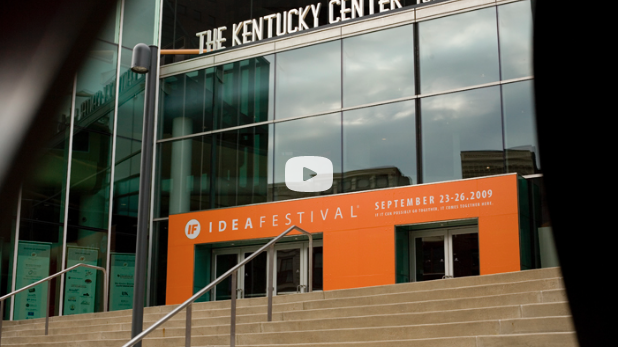


Founded in 2000, the IdeaFestival (IF) is a world-class event that attracts leading global innovators and thinkers to discuss and celebrate imagination, new perspectives and transformational ideas.

The IdeaFestival provides a unique stage to explore the cross-cutting nature of innovation involving a range of diverse disciplines, while supplying the creative tools needed to “see,” synthesize and apply this knowledge in new, dynamic ways.

IF Blog

It's a massive and richly detailed update on an icon taken by the crew of Apollo 17 at a distance of about 28,000 miles. (For comparion's sake, the ISS orbits at an altitude of less than 280 miles.)

The full sized retake, taken by the Earth observation satellite Suomi NPP, is enormous but well worth the time to download. It's simply gorgeous.

Wayne

Attribution Some rights reserved by NASA Goddard Photo and Video

Written in the context of a discussion on the cultural development of the "extrovert ideal" in Susan Cain's excellent book, "Quiet: The Power of Introverts in a World that Can't Stop Talking," the following quote ends with some gentle sarcasm. Cain carefully distinguishes "shy" from "introverted" - one fears social judgement, the other doesn't - and points out that the presumption about what the shy and introverted should like doesn't go in the other direction.

The pressure to entertain, to sell ourselves, and never to be visibly anxious keeps ratcheting up. The number of Americans who considered themselves shy increased from 40 percent in the 1970s to 50 percent in the 1990s, probably because we measured ourselves against ever higher standards of fearless self-presentation. 'Social anxiety disorder' — which essentially means pathological shyness — is now thought to afflict nearly one in five of us. The most recent version of the Diagnostic and Statistical Manual (DSM-IV), the psychiatrist’s bible of mental disorders, considers the fear of public speaking to be a pathology — not an annoyance, not a disadvantage, but a disease — if it interferes with the sufferer’s job performance. 'It’s not enough,' one senior manager at Eastman Kodak told the author Daniel Goleman, 'to be able to sit at your computer excited about a fantastic regression analysis if you’re squeamish about presenting those results to an executive group.' (Apparently it’s OK to be squeamish about doing a regression analysis if you’re excited about giving speeches.)

And the nerds rejoiced. We need every kind of mind.

Wayne

Poetry is what gets lost in translation. - Robert Frost

Jessa Crispin at Bookslut links to an interview with poet and translator Jonathan Galassi, who points out that the significance of good art in general, and poetry in particular, does not lie in being accepted at the moment. The Economist blog, Prospero:

Poetry has a vital place in society, whether it's granted one or not. It exists; it is something people perversely do. Whether it gets formal acknowledgment or is provided an established role is really not the ultimate point. There’s a lot of energy and money spent on trying to make a place for poetry in society; I'm all for it, and I work on this myself in various ways. But I don’t think it has anything to do with the art. Poetry is anti-establishment by nature—except when it's not, of course, and then it tends to be of little interest. True poetry gets absorbed ex post facto, when people understand that the poet is seeing something, knows something, that they didn't. And that is the poet's ultimate reward: to change perception, to enter the language, to matter. There's nothing more mainstream than that. And it's something you can't buy, can't force. It just happens.

I just like the idea that some things are inaccessible to our matrixed and Google-optimized culture, that "the poet is seeing something, knows something" that can't be contextualized on the spot.

Wayne

Latest IF Tweets